유리병 속 작은 세계
그릇이 곧 건축이 되는 미니어처 다이오라마 · 작품 18
[작은 세계] 주전자 속 목욕탕
작은 세계
A miniature Korean public bathhouse built inside a dented yellow aluminium kettle, photographed as a macro still life on a tiled counter. The lid is tipped open and leaning against the side, and the kettle's interior is the room: the curved wall becomes tiled walls, the water inside becomes the hot pool with real steam rising out of the spout and the open lid, and tiny bathers in towels sit on the rim as if it were the ledge of the tub. Three small massage beds, a stack of yellow plastic basins, a mirror strip and a row of taps are fitted around the inner wall, each element scaled to the kettle. Warm light glows up from inside, catching the steam. Real photographic macro of a physical handmade diorama: visible brush marks on the tiny painted figures, dust on the counter tiles, shallow depth of field with the spout sharp and the background falling off. The container is the architecture. No real company logo, no real brand name.
[작은 세계] 우산 속 장마 골목
작은 세계
A miniature rainy Korean alley built inside an open umbrella, photographed as a macro still life. The umbrella lies canopy-up on a wet floor, and its inside surface is the sky of the scene: the ribs read as the beams of an overcast sky and water beads run down the fabric and drip into the alley below. Around the inner rim, tiny two-storey shophouses with rolled shutters, an air-conditioning unit, a leaning bicycle and a hand-painted signboard are built into the curve, their roofs following the umbrella's slope. A shallow pool of real water covers the bottom, reflecting the tiny warm windows. One 2cm figure with a red umbrella stands in the puddle. Real photographic macro of a physical handmade diorama: visible glue seams, the umbrella's actual nylon weave and metal rib tips, real water droplets, shallow depth of field. The container is the architecture. No real company logo, no real brand name.
[작은 세계] 서랍 속 문방구
작은 세계
A miniature 1990s Korean neighbourhood stationery shop built inside a half-open wooden desk drawer, photographed as a macro still life from a low front angle. The drawer is pulled out about two thirds; its front panel and brass handle are the shop's threshold, its raw plywood sides are the shop's walls, and the runners underneath read as the kerb. Inside, floor-to-ceiling shelving is packed with tiny goods — notebooks, coloured pencil boxes, plastic toy capsules in a clear bin, a rack of stickers, a small refrigerator glowing. A capsule-toy machine and a wooden bench sit at the entrance where the drawer front drops away. A single warm bulb hangs from the underside of the desk above, lighting the interior. Real photographic macro of a physical handmade diorama: real wood grain and drawer dust, cut-paper packaging on the tiny products, visible scalpel marks, shallow depth of field. The container is the architecture. No real company logo, no real brand name, all packaging invented.
[작은 세계] 김밥 단면 아파트
작은 세계
A single slice of gimbap standing on end on a wooden board, photographed in macro, whose cut face is a cross-section of an apartment building. The seaweed wrapper is the outer wall, the ring of rice is the corridor slab, and the fillings inside are read as rooms: the yellow pickled radish strip becomes a lit hallway, the egg strip a kitchen with a tiny table, the carrot a child's room, the spinach a balcony thick with plants, the burdock a stairwell running through. Tiny figures 3mm tall inhabit them — one at a window, one carrying a box up the stair, laundry strung across one opening. Each room is lit from inside with warm points of light. Everything else about the gimbap is real food: glossy rice grains, sesame seeds, slightly torn seaweed at the edge, oil sheen, a few grains fallen on the board. Real photographic macro, shallow depth of field, the cut face sharp. The food is the architecture. No real company logo, no real brand name.
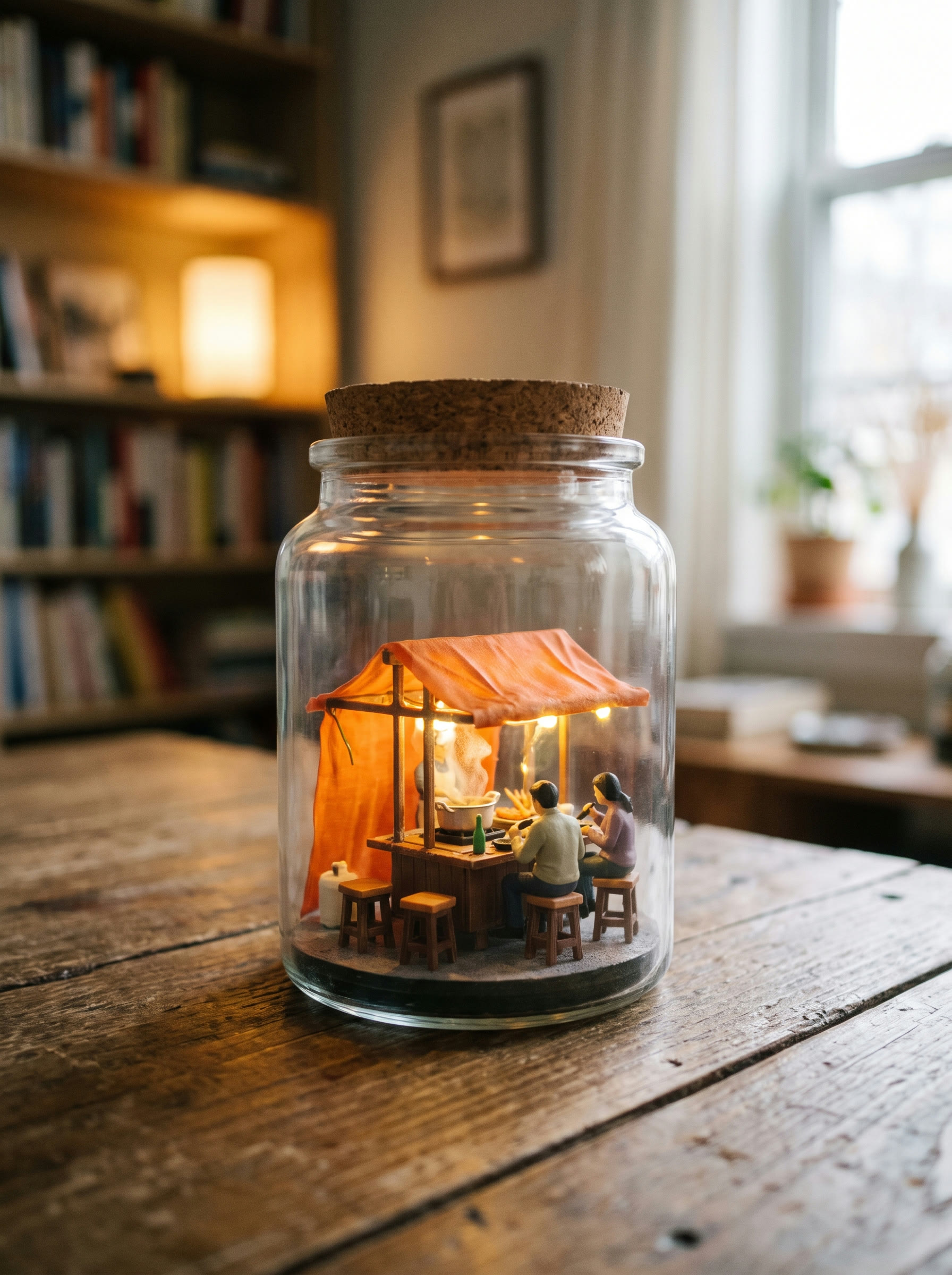
[작은 세계] 카세트 속 레코드숍
작은 세계
A miniature record shop built inside a transparent cassette tape shell, photographed in macro against a dark surface. The clear plastic housing is the shop's glass front; the two tape hubs become a spiral staircase and a circular listening booth; the exposed brown tape spooled between them reads as a low dividing wall. Two floors of tiny record bins run along the inside, sleeves standing on edge, with a counter and a turntable on the upper level and a customer flipping through a crate below. Small warm lights inside make the whole shell glow amber and throw the shop's shadow through the plastic onto the surface. The cassette's real details are kept exactly: the five screw posts, the pressure pad, the felt, the write-protect tabs, scuffs on the plastic, and a hand-written paper label on the front reading exactly "SIDE A" in ballpoint. Real photographic macro of a physical handmade diorama, shallow depth of field. The container is the architecture. No real company logo, no real brand name.
[작은 세계] 텐트 속 은하
작은 세계
A miniature night sky built inside a small camping tent, photographed in macro from just outside the unzipped door. The tent is real and about 20cm across, standing on a table; its dark inner fabric is the sky, pinpricked with hundreds of tiny fibre-optic stars and a soft dusty band of the Milky Way running from the door up over the ridge pole. Below the sky, a low miniature ridge line of dark hills and pine silhouettes runs around the tent's inside wall, with a two-figure campsite, a glowing ember fire the size of a match head, and a small telescope on a tripod pointed up at the fabric. Warm firelight spills out through the open door onto the table. The tent's real details stay: the zip teeth, the guy lines, the seam tape, a stitched loop, dust on the fabric. Real photographic macro of a physical handmade diorama, shallow depth of field, the tent door sharp. The container is the architecture. No real company logo, no real brand name.
[작은 세계] 연탄 속 지하도시
작은 세계
A miniature underground city built inside a coal briquette, photographed in macro on a concrete floor. The briquette stands upright and is cut away on one side to reveal that each of its nineteen round holes is a vertical shaft lined with tiny dwellings — small windows, ladders, walkways and washing lines spanning between shafts at different depths. Warm orange light glows up from deep inside each hole, so the whole cylinder is pierced with columns of light. Tiny figures climb the ladders and lean out of openings. The briquette itself stays absolutely real: pressed black coal dust texture, chipped edges, grey ash bloom on the surface, a fine dusting of coal powder on the concrete around it and on the photographer's fingertips at the frame edge. Real photographic macro of a physical handmade diorama, shallow depth of field, the cut face sharp. The object is the architecture. No real company logo, no real brand name.
[작은 세계] 편지봉투 속 우체국
작은 세계
A miniature village post office built inside an opened paper envelope, photographed in macro on a desk. The envelope lies with its flap folded back and propped open; the flap becomes the pitched roof, the paper body the walls, and the torn opening the doorway. Inside, a wooden counter with a brass scale, a rack of pigeonholes, a rubber stamp and ink pad, and bundles of tiny letters tied with string. A small red postbox stands just outside on the desk, with a bicycle leaned against the envelope's edge. A single warm bulb inside makes the paper glow translucent from within, so the envelope's fibres and the ghost of a folded letter still inside show through the walls. The envelope stays real paper: the gummed flap, a torn edge, a crease, a faint blue airmail border, and a cancelled stamp in one corner with an invented design. Real photographic macro of a physical handmade diorama, shallow depth of field. The container is the architecture. No real company logo, no real brand name.
[작은 세계] 자판기 속 야시장
작은 세계
A miniature night market built inside a drinks vending machine, photographed at night through its glass front. Each product shelf has become a street level: instead of cans, tiny food stalls with orange awnings, hanging bulbs and steaming pots line the racks, connected by narrow ladders between shelves, with small figures crowding the aisles. The machine's own lighting is the market's lighting — the internal strip lights read as neon signage, and coloured light spills out through the glass onto wet pavement in front. The vending machine stays completely real: the scratched acrylic front with reflections of the street behind the viewer, the coin slot, the row of chunky selection buttons, the delivery flap at the bottom with a warm glow coming out of it, and a scuffed painted steel frame. Shot from a low angle at night, shallow depth of field, the glass sharp with reflections and the interior slightly deeper. The machine is the architecture. No real company logo, no real brand name.